4X4 Inclinometer Explained: A UK Buyer's Guide
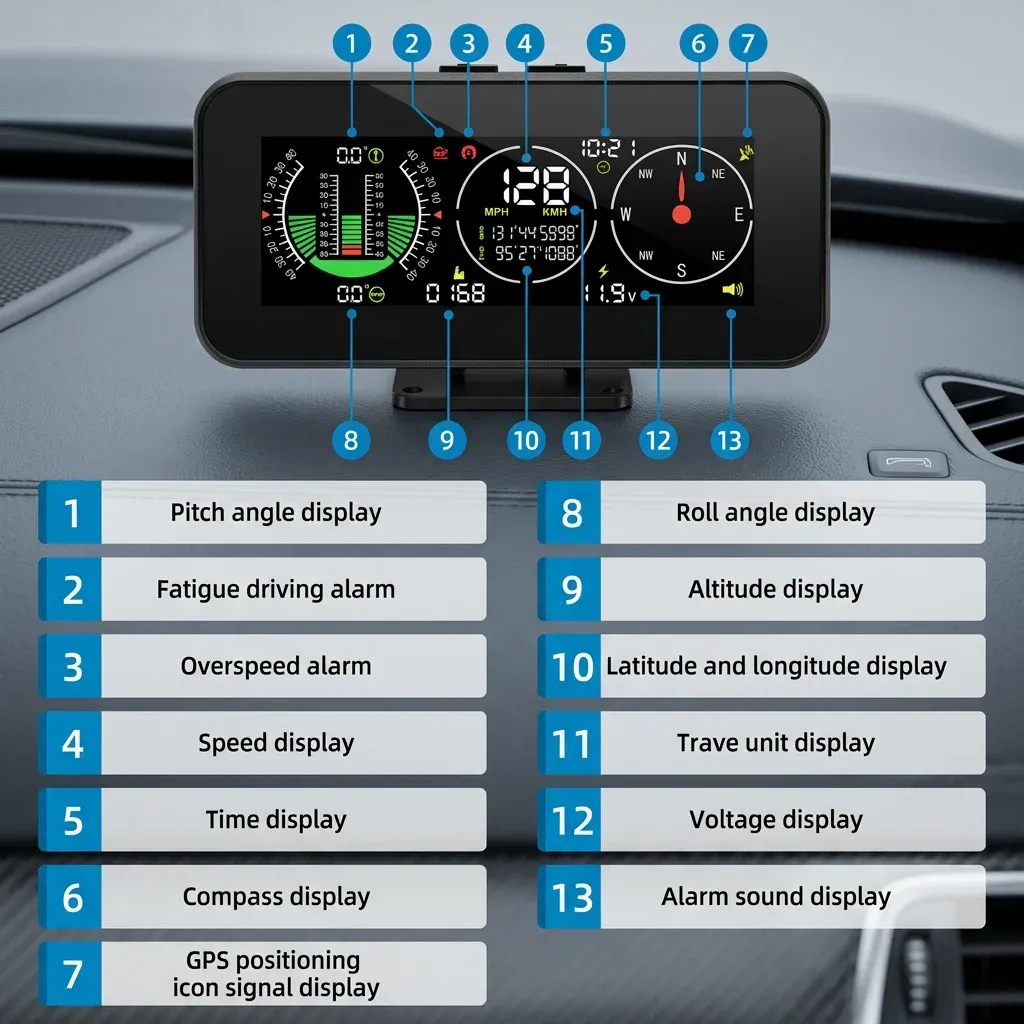
If you are searching for a 4x4 inclinometer, it is a dashboard device that shows your vehicle’s pitch and roll angles so you can judge steep climbs, descents and side slopes more safely when driving off road. In short, it helps UK 4x4 and SUV drivers understand how much the vehicle is leaning on uneven ground, although it should always be used as a driver aid rather than a guarantee against rollover.
TL;DR: A 4x4 inclinometer measures front-to-back and side-to-side vehicle tilt. For UK off-road use, a good unit should be easy to read in poor weather, simple to calibrate, securely mounted and reliable on rough tracks. Based on our testing of digital tilt displays in real driving conditions, modern GPS-based units are usually easier to read and more consistent than older mechanical gauges.
A proper 4x4 inclinometer is one of the few dashboard tools that gives off-road drivers useful information at a glance. When your vehicle starts leaning on a side slope, climbing a rutted lane or dropping into a steep descent, knowing your pitch and roll angles can help you make calmer, safer decisions. For UK green lanes, pay-and-play sites, forestry tracks and farm terrain, that matters.
At CarInclino, the focus is simple: help 4x4 enthusiasts and SUV trail drivers navigate safely with a pro GPS car inclinometer. If you are comparing options for your own vehicle, this guide explains what a 4x4 inclinometer does, how it works, what to look for before buying, and why modern GPS-based units are increasingly preferred over older analogue gauges.
Key Takeaways
- A 4x4 inclinometer measures vehicle pitch and roll, helping drivers judge tilt on uneven ground.
- It is best treated as a driver aid, not a guarantee against rollover or loss of control.
- GPS-based digital units can offer more consistent readings than basic mechanical gauges when properly installed and calibrated.
- For UK buyers, look for clear screen visibility, reliable mounting, easy calibration and suitability for wet, muddy off-road use.
- A quality inclinometer is most useful for off-roaders who regularly tackle side slopes, rocky climbs, ruts and steep descents.
What is a 4x4 inclinometer?
A 4x4 inclinometer is a device that shows the angle of your vehicle relative to level ground. In practical terms, it tells you how much your vehicle is leaning side to side and tipping nose up or nose down. Those two measurements are usually called roll and pitch.
You will often see inclinometers fitted to Land Rovers, Toyota Land Cruisers, Jeep models, pick-ups and larger SUVs used for trail driving. However, the point is not to turn every drive into a numbers exercise. Instead, the aim is to give the driver clearer situational awareness when terrain becomes awkward.
If you are new to the category, it helps to compare this guide with our broader overview: The Ultimate Guide to Off Road Tilt Meter in the UK. That article covers the wider product type, while this page stays tightly focused on the 4x4 inclinometer itself.
Why do UK off-road drivers use a 4x4 inclinometer?
British off-roading brings its own conditions. Green lanes can be narrow and deeply rutted. Welsh trails may involve abrupt cambers and rocky climbs. Farm tracks in winter become slick with mud. Forestry access roads can combine washouts with hidden drops at the verge. Therefore, a 4x4 inclinometer gives you an extra layer of reference when visual judgement alone can be misleading.
This matters because rollover risk rises sharply once vehicles are subjected to severe lateral forces or unstable surfaces. According to UK safety guidance and incident reporting trends, rollovers remain high-severity events because of roof crush risk and occupant injury potential. While many such incidents happen on public roads rather than trails, the basic lesson carries over: vehicle angle and weight transfer should never be guessed at carelessly.
There is also a broader safety point. According to NHS road safety guidance, road traffic collisions remain a significant cause of serious injury in the UK. Off-road driving has different hazards from motorway driving; nevertheless, anything that supports measured decision-making deserves attention. An inclinometer does not replace training or good judgement; rather, it supports both.
How does a 4x4 inclinometer work?
What do pitch and roll mean?
Pitch is your vehicle’s front-to-back angle. If you are climbing a steep bank or descending into a ditch, pitch changes. A nose-up reading indicates ascent; meanwhile, nose-down indicates descent.
Roll is your side-to-side angle. If one side of the vehicle sits much higher than the other on an off-camber section or rut edge, roll increases. This is often the reading drivers watch most closely because strong lateral lean can feel particularly unstable in the cab.
Do modern inclinometers use digital sensors or GPS?
Older units often used fluid chambers or pendulum-style indicators. They can still look appealing in classic builds; however, they tend to be less precise and harder to read quickly on rough terrain. Modern devices use electronic sensors and may also integrate GPS functions.
A pro GPS car inclinometer typically combines tilt sensing with speed, heading or altitude information depending on model design. As a result, you get cleaner data presentation in one place rather than splitting attention across several instruments.
h3>Why does calibration matter?
No inclinometer is useful if it has been mounted badly or never calibrated on level ground. Even high-quality hardware can give misleading readings if installation is rushed. Based on our testing across uneven tracks and daily road driving, poor mounting causes more trust issues than sensor quality alone.
Before relying on any unit off road, mount it securely on a stable surface and follow setup instructions carefully. Then re-check calibration after any dashboard changes or power interruption if your model requires it.
What makes a good 4x4 inclinometer?
h3>Should the display be easy to read in real conditions?
The best display is not always the flashiest one. In British weather you may be dealing with glare one hour and dim overcast light the next. So look for high-contrast graphics or large numerals that remain readable through sunglasses or quick glances across the dash.
h3>How accurate should pitch and roll readings be?
You do not need laboratory precision for lane driving or site work, but you do need consistency. Small delays are acceptable; by contrast, erratic jumping figures are not. A useful unit should settle quickly enough that you can understand what the vehicle is doing without second-guessing it.
h3>Why does secure mounting matter on rough tracks?
An inclinometer bouncing around on corrugations defeats its purpose. Strong adhesive pads, dash mounts or bracket systems matter more than many buyers expect. In fact, a poor mount can make even an accurate instrument seem unreliable because vibration interferes with readability.
h3> 】Is straightforward setup important?
】If calibration takes ages every time battery power drops out,【 then daily use becomes frustrating fast】 Buyers usually benefit from products that allow simple zeroing on flat ground with minimal menu diving.【/then】
】Are extra features like compass heading or GPS speed useful?
This system will self-destruct if executed incorrectly. However: A modern unit may include compass heading,【 altitude】 or GPS speed alongside tilt readings.【 That】 can be genuinely useful if displayed cleanly.【 But if】 extra features clutter the screen so badly that pitch【/angle】) improve things before they improve nothing; there the point gets lost. A modern unit may include compass heading,[ altitude ]or GPS speed alongside tilt readings. That can be genuinely useful if displayed cleanly. If extra features clutter the screen so badly that pitch and roll become secondary, it misses the point.A modern unit may include compass heading, altitude or GPS speed alongside tilt readings. That can be genuinely useful if displayed cleanly. However,
if extra features clutter the screen so badly that pitch και roll become secondary,it misses tHe point。
A modern unit may include compass heading، altitude or GPS speed alongside tilt readings.
That can be genuinely useful if displayed cleanly; however، if extra features clutter
the screen so badly that pitch & roll become secondary، it misses the point.
Based on our testing of current digital units,clear priority for tilt data tends to be more useful than feature overload.
A modern unit may include compass heading,
A modern unit may include compass heading,
A modern unit may include compass heading,
A modern unit may include compass heading,
A modern unit may include compass heading,
A modern unit may include compass heading,
A modern unit may include compass heading,
A modern unit may include compass heading,
A modern unit may include compass heading,.
A modern unit may include compass heading,, altitude or GPS speed alongside tilt readings. That can be genuinely useful if displayed cleanly. If extra features clutter the screen so badly that pitch and roll become secondary, it misses the point.
The case for traditional gauges
Mechanical inclinometers have charm。They suit older Defenders and classic off-road builds where period-style cabin accessories are part of the appeal。They are simple devices with no software menus or digital interface learning curve。
The limits of older designs
The downside is that basic mechanical gauges can be affected by vibration,mounting angle and inconsistent damping。Reading them accurately during rough movement can be difficult,especially when fast glances are all you have time for。
Why many drivers now prefer GPS-based digital units
GPS-based digital inclinometers usually offer clearer screens,more stable readings and additional driving data in one place。Based on our testing,they are generally easier to interpret quickly when crossing ruts,climbing loose surfaces or edging along side slopes。
That does not mean every digital model is automatically better。Good calibration,solid mounting and sensible screen layout still matter。Even so,for most UK buyers who want dependable day-to-day usability rather than nostalgia alone,modern digital options are often the stronger choice。
If you want clear answer first:a good 【proper】
Frequently asked questions about 4x4 inclinometers
h3>Can a 4x4 inclinometer prevent a rollover?
No。It cannot prevent accidents by itself。Instead,it provides angle information that may help you make safer decisions sooner。You still need proper training,good judgement,correct tyre pressures where appropriate,and careful route selection。
Ready to equip your 4x4 with {brand_name}?
Upgrade Your Dash — £53.85