Vehicle Pitch And Roll Gauge Explained: A UK Buyer's Guide
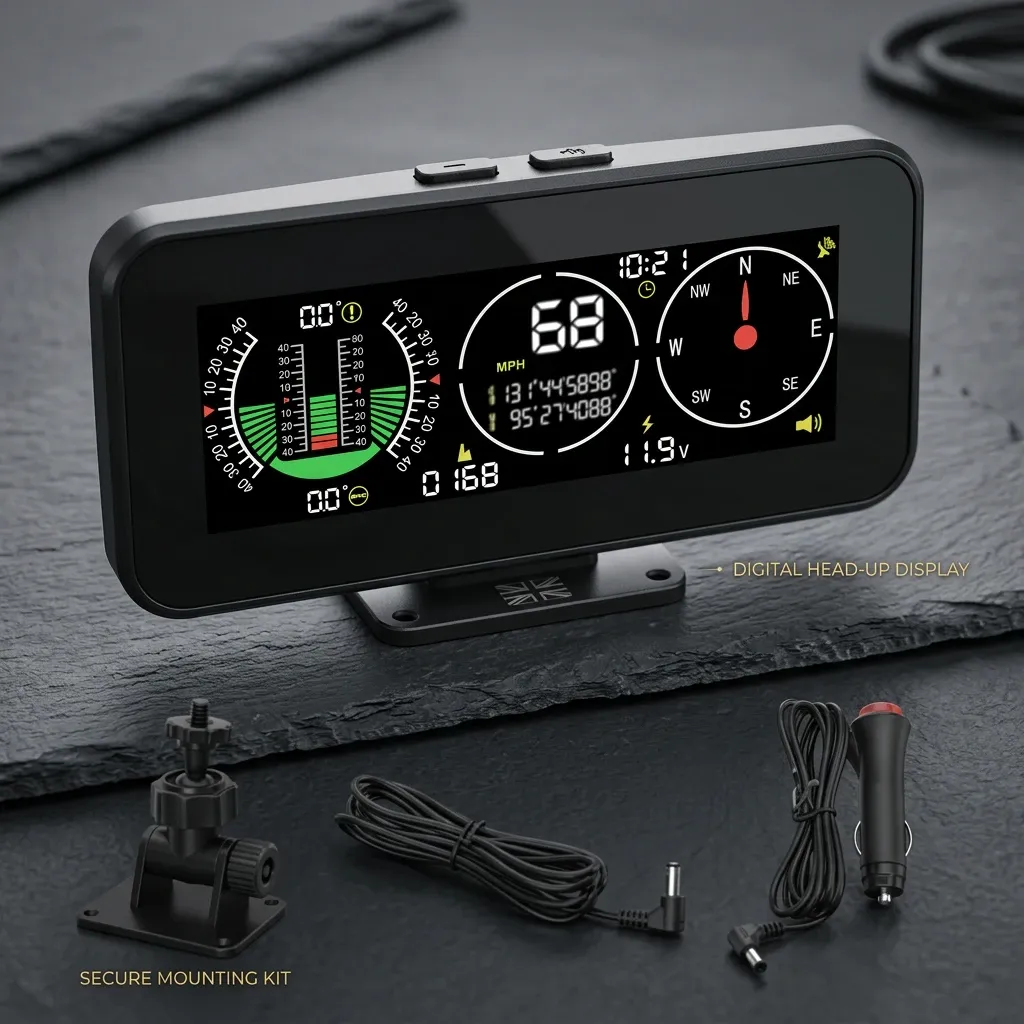
TL;DR: A vehicle pitch and roll gauge is a dashboard instrument that shows your vehicle’s front-to-back pitch and side-to-side roll angles in real time. For UK 4x4, SUV and pickup drivers, it helps judge stability on uneven ground, especially on green lanes, farm tracks, quarry access roads and private estates where visual judgement can be misleading.
A vehicle pitch and roll gauge measures how much your vehicle is leaning forwards, backwards or sideways, helping you make safer decisions on uneven or off-camber ground. In practice, it is most useful for UK drivers who use a 4x4, pickup or SUV on green lanes, muddy tracks, estates, farms or expedition routes where judging tilt by eye alone is difficult.
Key Takeaways
- A vehicle pitch and roll gauge shows your vehicle’s front-to-back and side-to-side tilt, helping drivers judge stability on uneven ground.
- For UK 4x4 and SUV owners, a good gauge is most useful on green lanes, farm tracks, quarry access roads, private estates and expedition travel where visual judgement alone is unreliable.
- Digital GPS-based inclinometer units can offer steadier readings, cleaner installation and extra trip data compared with older mechanical dials.
- Buying decisions should focus on readability, calibration, mounting position, power supply, weather resilience and whether the display remains clear in poor British light.
- A pitch and roll gauge is a decision aid, not a licence to exceed safe vehicle limits or ignore manufacturer guidance.
On a wet rutted lane in North Yorkshire or a rocky access track in Eryri (Snowdonia), the ground rarely looks as steep from the driver’s seat as it really is. As a result, the gap between what feels manageable and what is actually safe is exactly where a vehicle pitch and roll gauge earns its place on the dashboard.
For UK drivers who take a 4x4, pickup or SUV beyond tarmac, understanding vehicle attitude is not a gimmick. Instead, it is a practical way to make better decisions when the terrain becomes off-camber, the weather closes in, or visibility is reduced by mud, hedgerows or darkness. A clear inclinometer display can help you spot when the body angle is increasing faster than expected and when it is time to reassess the line, stop or reverse out.
Based on our testing of GPS-based inclinometer displays in British driving conditions, readability and stable real-time data matter far more than flashy graphics. CarInclino’s focus is simple: help drivers navigate more safely with a pro GPS car inclinometer. If you are comparing options, this guide explains what a vehicle pitch and roll gauge does, who it is for, what to look for in the UK market and how to choose one that adds real value rather than just another dashboard accessory.
What is a vehicle pitch and roll gauge?
A vehicle pitch and roll gauge is an instrument that measures how much a vehicle is tilted in two directions:
- Pitch: the front-to-back angle, such as climbing a steep bank or descending a muddy slope.
- Roll: the side-to-side angle, such as crossing ruts, traversing an off-camber lane or leaning into a side slope.
In practical terms, the gauge gives the driver a clearer picture of how the vehicle is sitting relative to level ground. Some units use traditional pendulum-style mechanics, while newer products use electronic sensors or GPS-assisted systems to display real-time readings.
The point is not to chase dramatic numbers. Rather, the point is to improve judgement. Even experienced off-road drivers can misread terrain from the cab, especially in rain, low winter sun or when the bonnet obscures the breakover ahead. A vehicle pitch and roll gauge turns that guesswork into usable information.
For a broader overview of off-road tilt monitoring in Britain, see The Ultimate Guide to Off Road Tilt Meter in the UK.
What does a vehicle pitch and roll gauge do?
A vehicle pitch and roll gauge shows live tilt angles so you can understand how steeply your vehicle is climbing, descending or leaning to one side. Therefore, it acts as an extra reference point when terrain looks flatter from the cab than it really is.
This matters because body movement can feel dramatic even when readings remain moderate; equally, some slopes feel deceptively calm until ruts or soft verges increase lean unexpectedly. According to UK off-road training principles and manufacturer guidance for many 4x4 vehicles, drivers should treat angle information as an aid to caution rather than permission to push further.
Why do UK drivers use a vehicle pitch and roll gauge?
British off-roading has its own character. Routes are often narrower than in other markets, surfaces are more likely to be waterlogged and elevation changes can be hidden by vegetation, stone walls or hedgebanks. In other words, you are rarely driving vast open desert tracks; instead, you are threading a tall vehicle through cambers, washouts and slippery climbs where precision matters.
That is why a vehicle pitch and roll gauge appeals to several groups of drivers:
- 4x4 enthusiasts using legal green lanes and byways.
- SUV owners who regularly drive rough private land, forestry access routes or remote holiday sites.
- Farmers and estate workers crossing uneven tracks in all weather.
- Expedition travellers preparing for trips in the UK and abroad.
- Drivers towing or carrying gear who want a better read on changing balance.
There is also a genuine safety angle here. According to Department for Transport reported road casualty figures, 1,695 people were killed on Great Britain’s roads in 2023, with many more seriously injured. Source: Department for Transport. Although those figures are not specific to off-road driving, they underline how much hazard awareness and measured decision-making matter in any driving environment.
A pitch and roll gauge will not replace training, tyre choice or common sense. However, it does give you another layer of information when misjudging a side slope or descent can be expensive at best and dangerous at worst.
How does a vehicle pitch and roll gauge help in real driving conditions?
How can it help you read side slopes more accurately?
Side slopes are where many drivers feel least comfortable. The cabin lean can feel dramatic long before the vehicle is near its actual limit; however, the opposite can also happen: a slope may look mild while hidden ruts and soft verges increase the real roll angle. A gauge gives you a steadier point of reference so you can decide whether to continue, alter your line or back out.
How can it help on steep climbs and descents?
On climbs, pitch readings help you understand how sharply the nose is rising and whether your approach remains controlled. On descents—especially greasy winter ones—the display supports a more measured approach as you combine engine braking, low range and careful steering input.
Can it improve confidence without encouraging risky driving?
The best use of a vehicle pitch and roll gauge is conservative. It should help you recognise caution points sooner rather than tempt you into driving closer to rollover thresholds. Used properly, it can make a novice more disciplined and an experienced driver more precise.
Does it help passengers feel more reassured?
If you have ever driven family or friends across rough ground, you will know passenger confidence can disappear quickly when the vehicle starts leaning. A visible easy-to-read display can make the situation feel more controlled because the driver is working from real data rather than rough guesswork alone.
Is a digital or mechanical vehicle pitch and roll gauge better?
Most buyers in the UK will come across two broad formats: traditional mechanical gauges and digital inclinometer-style units. In general, digital units suit most modern buyers better because they tend to be easier to read accurately in mixed conditions.
Mechanical gauges
These typically use a pendulum or weighted pointer inside a dial. They have straightforward appeal and may suit classic 4x4 interiors well. They are often simple to understand at a glance and may not require complex setup.
The trade-off is that mechanical gauges can be more affected by vibration, mounting angle and inconsistent readability—particularly on washboard surfaces or in poor light. Cheap units also vary widely in build quality.
Digital gauges
Digital products use sensors to calculate tilt and present information on a screen; often they add extra data such as heading, altitude, battery voltage or GPS speed. A well-designed digital unit generally offers clearer readings with less visual ambiguity than older dial-based models.
Which type makes most sense for UK conditions?
Based on our testing experience with dashboard-mounted displays used in low light, rain glare and uneven terrain common across Britain, digital GPS-based units usually provide better day-to-day usability. That said, buyers should still check update speed first rather than assuming every digital model performs well under vibration or tree cover.
Ready to equip your 4x4 with {brand_name}?
Upgrade Your Dash — £53.85