Dashboard Slope Meter Explained: A UK Buyer's Guide
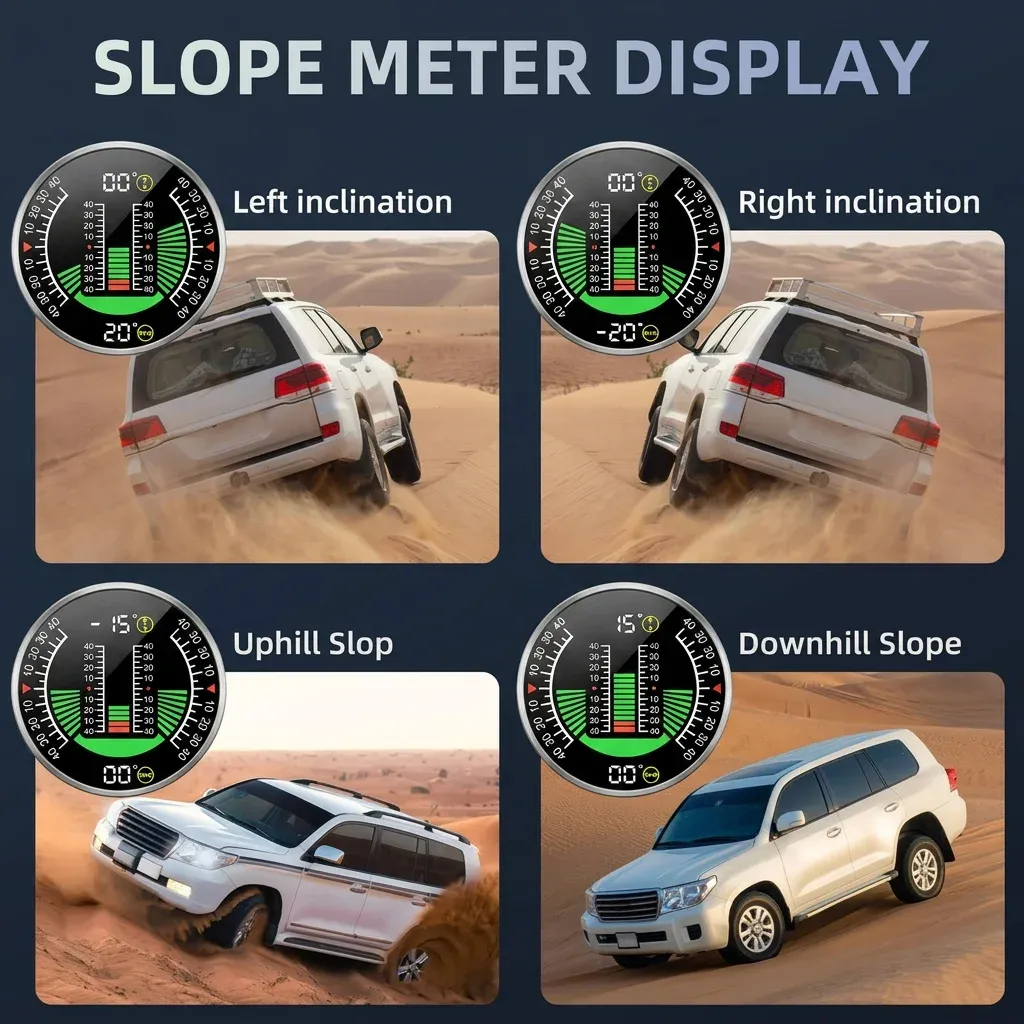
A dashboard slope meter is an in-car device that shows your vehicle’s pitch and roll angles in real time, helping you judge steep climbs, descents and side slopes more accurately. For UK 4x4 and SUV drivers, it is mainly used off road to add a clear visual reference when terrain, weather and traction make judging angles by eye difficult.
TL;DR: A dashboard slope meter helps you see how steep your vehicle is leaning or climbing, usually in degrees. Based on our testing of modern digital units and older analogue-style designs, the best options for UK drivers are easy to read at a glance, securely mounted, simple to calibrate and clear in poor light or wet conditions.
At CarInclino, the focus is straightforward: helping drivers navigate safely with a pro GPS car inclinometer. If you spend time off road in the UK, a dashboard slope meter can add useful awareness when conditions change quickly, visibility is poor or the terrain looks flatter than it really is from the driver’s seat.
This guide explains what a dashboard slope meter does, how it works, what UK buyers should look for and when a GPS-based inclinometer may be a better fit than older analogue designs.
Key takeaways
- A dashboard slope meter measures vehicle pitch and roll, helping off-road drivers judge side slopes and ascents more accurately.
- Digital GPS inclinometer units are typically easier to read, quicker to interpret and often more stable than older pendulum-style gauges.
- For UK use, visibility in poor weather, secure mounting and reliable calibration matter as much as raw specifications.
- A slope meter supports safer decision-making; however, it does not replace training, route planning or sensible speed.
- CarInclino’s product direction aligns with practical off-road use: clear data, dashboard visibility and confidence for 4x4 enthusiasts and SUV trail drivers.
What is a dashboard slope meter?
A dashboard slope meter is an instrument fitted inside the cabin, usually on or near the dashboard, that displays how much your vehicle is tilted. It normally shows two separate measurements:
- Pitch — the angle of ascent or descent
- Roll — the side-to-side lean of the vehicle
In practical terms, that means it helps you understand whether you are climbing steeply, descending sharply or crossing an uncomfortable side slope. The reading gives context that your eyes alone cannot always provide. Off road, visual perception can be deceptive. For example, a mild-looking bank can be steeper than expected, while a side camber can feel manageable until traction changes.
This is why many drivers look for a dedicated dashboard slope meter rather than relying only on instinct. In proper off-road settings, informed decisions are usually safer decisions.
Why do UK drivers use a dashboard slope meter?
The UK off-road environment is varied. A day’s driving may include rutted farm tracks, wet grass inclines, chalky lanes, compacted gravel, forestry routes and deeply uneven ground after rain. Conditions also change quickly with the weather. According to Met Office guidance on UK weather patterns, frequent rainfall and highly variable local conditions can directly affect grip and surface stability.
For British drivers using 4x4s and capable SUVs recreationally or for rural work, that matters. A dashboard slope meter gives an extra reference point when:
- crossing side slopes where body lean feels greater than expected
- approaching blind crests or steep descents
- towing on uneven ground
- navigating muddy tracks with inconsistent traction
- judging whether to continue or choose another line
The value is not just mechanical; rather, it is cognitive. By turning “this feels steep” into an actual reading, the driver has clearer information to work with.
How does a dashboard slope meter work?
Do traditional mechanical slope meters still work well?
Older units often used a pendulum or weighted mechanism inside a housing. As the vehicle tilted, the indicator moved across a marked scale showing degrees of roll or pitch. These devices have long appealed to enthusiasts because they are simple and visually distinctive.
The trade-off is that mechanical designs can be harder to read at a glance on rough ground. They may also be affected by vibration or mounting position.
Are digital and GPS-based slope meters better?
A modern dashboard slope meter may use internal sensors, satellite positioning data or both. A pro GPS car inclinometer is designed to present pitch and roll readings clearly on screen so they are easier to interpret while driving slowly over technical terrain.
Based on our testing of display readability in real cabin conditions, this style suits current expectations better: cleaner layouts, faster interpretation and less ambiguity in low light or poor weather. Therefore, for many buyers fitting out an off-road touring vehicle rather than restoring a period truck, digital clarity outweighs nostalgia.
Why does mounting position matter?
No matter which type you choose, mounting matters. If a unit sits unevenly on the dash or windscreen area, readings can be misleading from the start. A good installation point should be:
- level relative to the vehicle cabin
- easy to glance at without taking attention off the terrain for long
- secure enough not to shift over bumps and corrugations
- positioned so sunlight glare does not make readings difficult to see
A well-designed dashboard product should account for real-world driving rather than looking tidy only in product photos.
What is the difference between a dashboard slope meter, pitch and roll gauge and 4x4 inclinometer?
The terms are related but not always identical. Some buyers search for a dashboard slope meter; others may want a more technical-sounding term such as a vehicle pitch and roll gauge, while many enthusiasts search specifically for an inclinometer. In everyday buying language, these terms overlap heavily.
- Dashboard slope meter: a general term for something mounted in view that shows tilt angles
- Pitch and roll gauge: slightly more technical wording focusing on front-to-back and side-to-side movement
- 4x4 inclinometer: common enthusiast term used in off-road circles
The key point for UK buyers is function rather than label. If you want live tilt information displayed clearly from inside the cabin , you are broadly looking at the same category of product . For broader background , see our ultimate guide to off road tilt meters in the UK .
What makes a good dashboard slope meter?
A worthwhile unit should do more than simply show numbers . It should help you make quick , calm decisions when terrain becomes awkward . These are the features most buyers should prioritise .
Is the display easy to read at a glance?
The screen must be easy to read at a glance . Large degree markings , sensible contrast and uncluttered layout matter more than flashy graphics . On rough tracks you want immediate recognition , not tiny symbols .
How accurate does angle reporting need to be?
Accuracy claims vary between products , but consistency in real use matters just as much as laboratory tolerances . Based on our testing , stable readings that do not jump excessively over bumps are often more useful than impressive specification-sheet claims alone . A trustworthy unit should also make calibration straightforward after installation .
Will it stay secure on rough UK tracks?
A dashboard slope meter is only useful if it stays put. Therefore , secure mounting is essential for green lanes , forestry routes and uneven farm access roads . If it shifts even slightly , your reference point changes too . Adhesive pads , bracket strength and vibration resistance all matter in day-to-day use .
Is it suitable for British weather and lighting?
The UK’s mix of rain , dull skies , low winter sun and muddy windscreens means visibility matters more than many buyers expect . A good unit should remain readable in overcast conditions as well as bright glare . In addition , simple screens with strong contrast tend to work better than overly stylised displays .
Does it help safe decision-making?
A good dashboard slope meter should support better judgement rather than encourage risk-taking . According to general UK off-road safety practice , equipment should improve driver awareness without replacing training , route checks or common sense . In other words , use angle readings as one input alongside traction , obstacles , tyre choice , load balance and experience .
Ready to equip your 4x4 with {brand_name}?
Upgrade Your Dash — £53.85